Internet lore
Japan · 2004
- Status
- Fictional station
- Reading time
- 8 minutes
- Origin
- 2channel thread
- Confidence
- Origin documented
The last stop outside the map
Kisaragi Station
In January 2004, an anonymous commuter asked strangers online why her train had stopped following its route. Over the next several hours, those strangers watched a new kind of ghost story unfold in real time.
By the Yokai Signal editors · Published · Updated
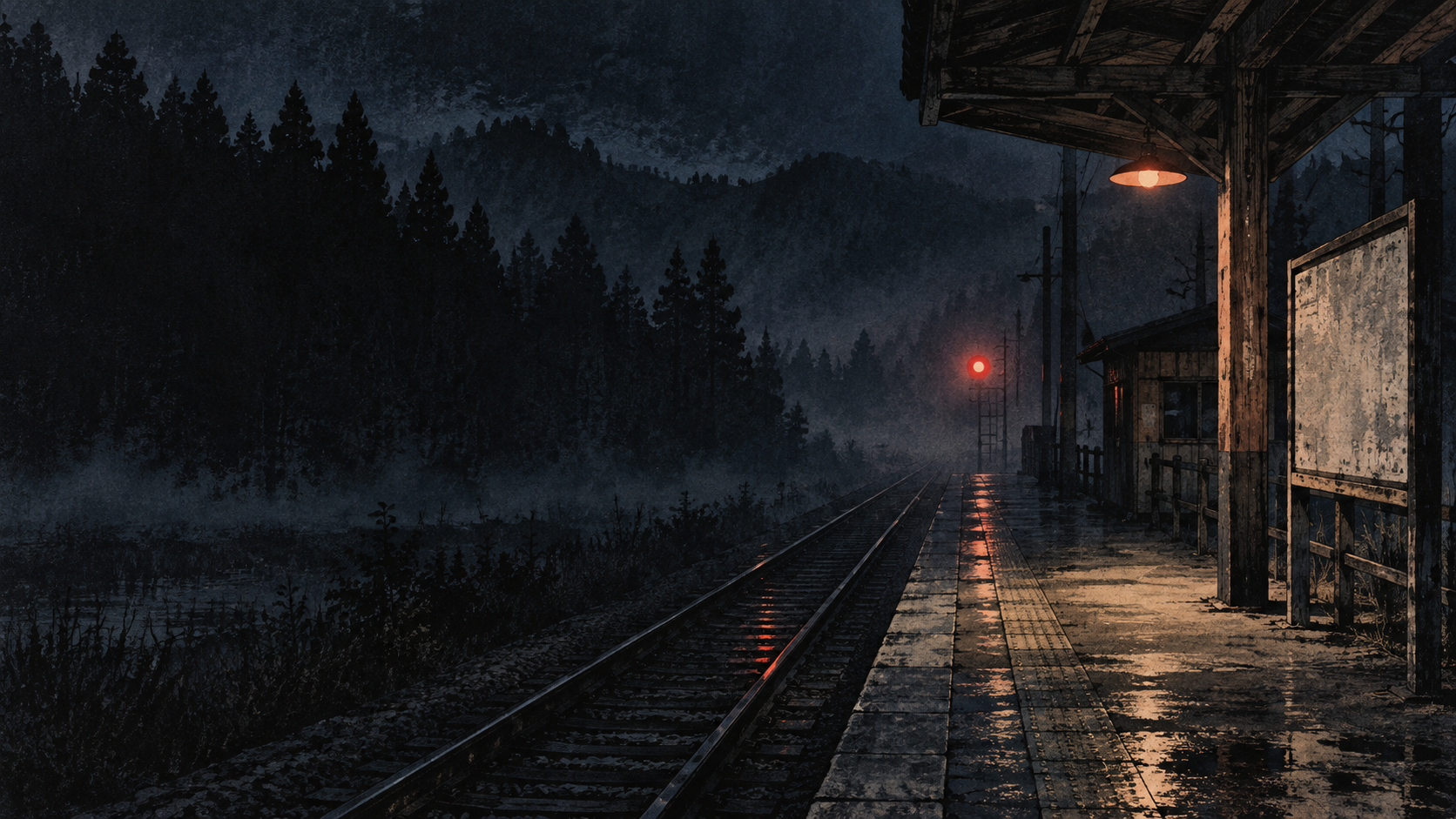
Every legend leaves two records: the story people repeat, and the path it took to reach them.
01 / THE STORY
A ghost story born as a live conversation
The standard retelling goes like this. A young woman is riding a private-railway train home late at night. The train keeps running far longer than it should, the other passengers are asleep, and nobody comes through from the driver’s end. Eventually it stops at a platform with no staff, no town lights and a name she has never heard: Kisaragi. She gets off, finds nothing, and starts to follow the tracks on foot. Strange sounds and a stranger’s offer of a lift follow, and her messages stop.
What makes it unusual is that the story was never delivered as a story. It was typed out in public, minute by minute, to people who answered back. Their replies, doubts and bad advice are part of the record, and that is why Kisaragi Station is remembered as an event rather than only a text.
The innovation was not a new monster. It was the interface: timestamps, usernames, battery anxiety, and a crowd trying to help.
02 / THE TRACE
What the archived thread actually contains
The thread is a “live report” thread on 2channel’s occult board, titled roughly “Report it live if something strange happens around you, part 26”. Its first post is dated 7 January 2004. The commuter’s story begins late on the 8th: at 23:14 someone writes that something may be only their imagination, and at 23:23 explains that on a train they use every day, nothing has stopped for about twenty minutes, although stops normally come every five minutes or at most seven or eight. Five other passengers, they say, are asleep.
Readers push the poster to look for the conductor, name the line and write down station names. The poster begins posting with the handle “Hasumi” (written 葉純 later in the thread) shortly after midnight, and at 00:25 on the 9th reports that the train is standing at a station called Kisaragi. A little later she gets off. She says she cannot find a timetable, then that there are no taxis and nothing around, then that her parents cannot locate the station on a map. A reader compiles a running summary at about 01:34, a sign of how quickly the crowd treated the thread as shared property.
At roughly 01:55 she says she called the police and was told off for making a prank call. After that the posts turn eerie: a sound like drums mixed with bells, a one-legged old man who calls out a warning and then vanishes, and a tunnel whose sign she reads as Isanuki. At about 03:10 she is through the tunnel and someone is waiting; at 03:20 she says a kind stranger will drive her to a nearby station. By 03:37 the car is heading uphill into the mountains and the driver has stopped talking, and the 03:44 post, the last in this sequence, says her battery is nearly gone and she will try to slip away.
Two days later, posts under the same handle say she escaped and was caught. One of them carries a different tripcode (the short identity hash that 2channel users appended to their names) from the thread’s earlier Hasumi posts, so even the sequel material is not clearly from one author. Treat everything after 03:44 as the part of the story that the internet kept writing for itself.
Times above are paraphrased from the Internet Archive copy of the thread. Post numbers and timestamps come from that snapshot; the text of the posts is deliberately not reproduced.
03 / THE WORDS
Terms worth knowing
Kisaragi (きさらぎ, written 如月 in kanji) is the traditional name for the second month of the lunar calendar. In the thread it appears in hiragana, and the odd spelling was one of the first things readers noticed when they tried and failed to find the station in any listing.
A “jikkyō” (実況) thread is a live-report thread, a genre in which people narrate what is happening to them in real time. It sits between a diary and a performance, and it is the format that gave Kisaragi its pull. The railway involved is identified in the thread by the departure point, Shin-Hamamatsu, which belongs to Enshu Railway in Hamamatsu, Shizuoka Prefecture.
04 / VARIATIONS
Copies, fakes and sequels
Because the account was written as a first-person live report, it was easy to imitate. Later stories invented stations such as Tsuki-no-miya, Yami and Katasu in the same style, and many of the “real” Kisaragi photographs and later reports that circulated on social media turned out to be fiction, sometimes illustrated with pictures of real stations.
Later “returns” and look-alike stations circulate too, such as claims by people using the Hasumi name and map pins named Kisaragi Station, but we could not trace any of them to a source we opened, so we do not treat them as part of the record. What can be said is that the legend had become a shared joke as well as a scare, which is why such copies keep appearing.
05 / CONTEXT
Why 2004, and why a train
In 2004 the people in that thread were reading on keitai (Japanese mobile phones) and desktop browsers, often posting anonymously and expecting the page to be gone in a day. Folklorist Yoshiyuki Iikura, speaking to Nippon.com, describes legends of this period as a second wave: pseudo-realistic first-person accounts that readers can add to. By his account, once a story reached a certain length, aggregator sites picked it up and it spread again, and from around 2010 social media interaction drove legends further.
The choice of a commuter train is also telling. A suburban line is a system of repetition: each stop proves that the world still makes sense. One wrong station turns the whole network uncanny. The poster’s own phone is part of the trap; it connects her to strangers and to her parents, but cannot tell anyone where she is.
06 / AFTERLIFE
When the fictional station entered the real world
Readers associated the story with Enshu Railway because of the Shin-Hamamatsu start, and Saginomiya (さぎの宮) Station became the most commonly named model. Enshu’s own page calls Kisaragi a station that does not really exist, while acknowledging the connection. On 8 January 2022 the railway sold a one-day set of 500 commemorative tickets for 500 yen each, including a replica Shin-Hamamatsu to Kisaragi ticket, and decorated part of the Saginomiya name sign to read “Kisaragi” for the day. The date was chosen to match the original posts.
The legend has since been reworked in fiction of various kinds. The clearest documented adaptation is the feature film Kisaragi Station, directed by Jiro Nagae and starring Yuuri Tsunematsu, which was released in Japan on 3 June 2022; its sequel Kisaragi Station Re: followed in 2025.
07 / WHY IT WORKS
The audience was inside the haunted house
Earlier urban legends usually arrived as finished stories: a friend of a friend saw something, and the listener received the tale whole. Kisaragi Station felt different because readers encountered it as an unresolved problem. The pauses between posts created suspense, while every suggestion in the thread made the readers participants.
This is interpretation rather than record, but the effect is easy to test. Read the posts in order and you notice how often the helpful readers sound exactly like people anywhere would: check the conductor, call a taxi, call the police. The story’s dread comes from those sensible suggestions failing one by one.
08 / TIMELINE
The record, in order
- 7 Jan 2004
The 2channel occult-board live-report thread that will host the story begins.
- 8 Jan 2004, 23:14
An anonymous commuter opens with a hesitant post. By 23:23 she says the train has not stopped for about twenty minutes.
- 9 Jan, 00:08
The poster appears under the handle Hasumi. At 00:25 she reports a stop at Kisaragi Station.
- 9 Jan, 01:55
She says the police dismissed her call as a prank; sounds and a figure on the tracks follow.
- 9 Jan, 02:45
She reaches a tunnel she reads as Isanuki, and says she will go through.
- 9 Jan, 03:44
Her last post in the main sequence: the driver of the car is behaving oddly and her battery is low.
- 8 Jan 2022
Enshu Railway sells 500 commemorative Kisaragi ticket sets on the anniversary of the thread.
- 3 Jun 2022
The feature film Kisaragi Station opens in Japan.
09 / QUESTIONS
Common questions
Is Kisaragi Station real?
No. The station is fictional, and Enshu Railway’s own page says it does not actually exist. The 2004 thread is real, in the sense that it can be read in an archive, but there is no evidence for the events it describes. Many other posts and photos presented as proof later turned out to be fiction or unrelated pictures.
Which railway line is Kisaragi Station supposed to be on?
The thread gives Shin-Hamamatsu as the starting point, which is the terminus of Enshu Railway in Hamamatsu, Shizuoka. Readers have guessed that Saginomiya Station is the model, partly because it is about twenty minutes from Shin-Hamamatsu. That is speculation by readers, not something the original poster confirmed.
What does Kisaragi mean?
Kisaragi is an old name for the second month of the lunar calendar, written 如月 in kanji. In the thread it appears in hiragana. The name has no connection to a real place, which is part of the point: it sounds like a station, but no timetable lists it.
Did the poster, Hasumi, really disappear?
There is no evidence of a missing-person case. The posts ended in the early morning of 9 January 2004, and later messages under the same name were inconsistent and unverified. The thread is best read as a collaborative ghost story.
10 / SOURCES
Follow the signal
Sources are listed by what they help establish. A source documenting a legend’s circulation is not proof that the supernatural event occurred.
11 / RELATED
Continue the trail
Browse the full archive or see every legend on the timeline.