Independent folklore archive
YOKAI
SIGNAL
Japanese internet mysteries, urban legends, and modern folklore — translated with context, traced to their origins, and clearly separated from what can be verified.
Osaka / Online
Est. 2026
Featured dossier
FILE 001 / 8 MIN READ
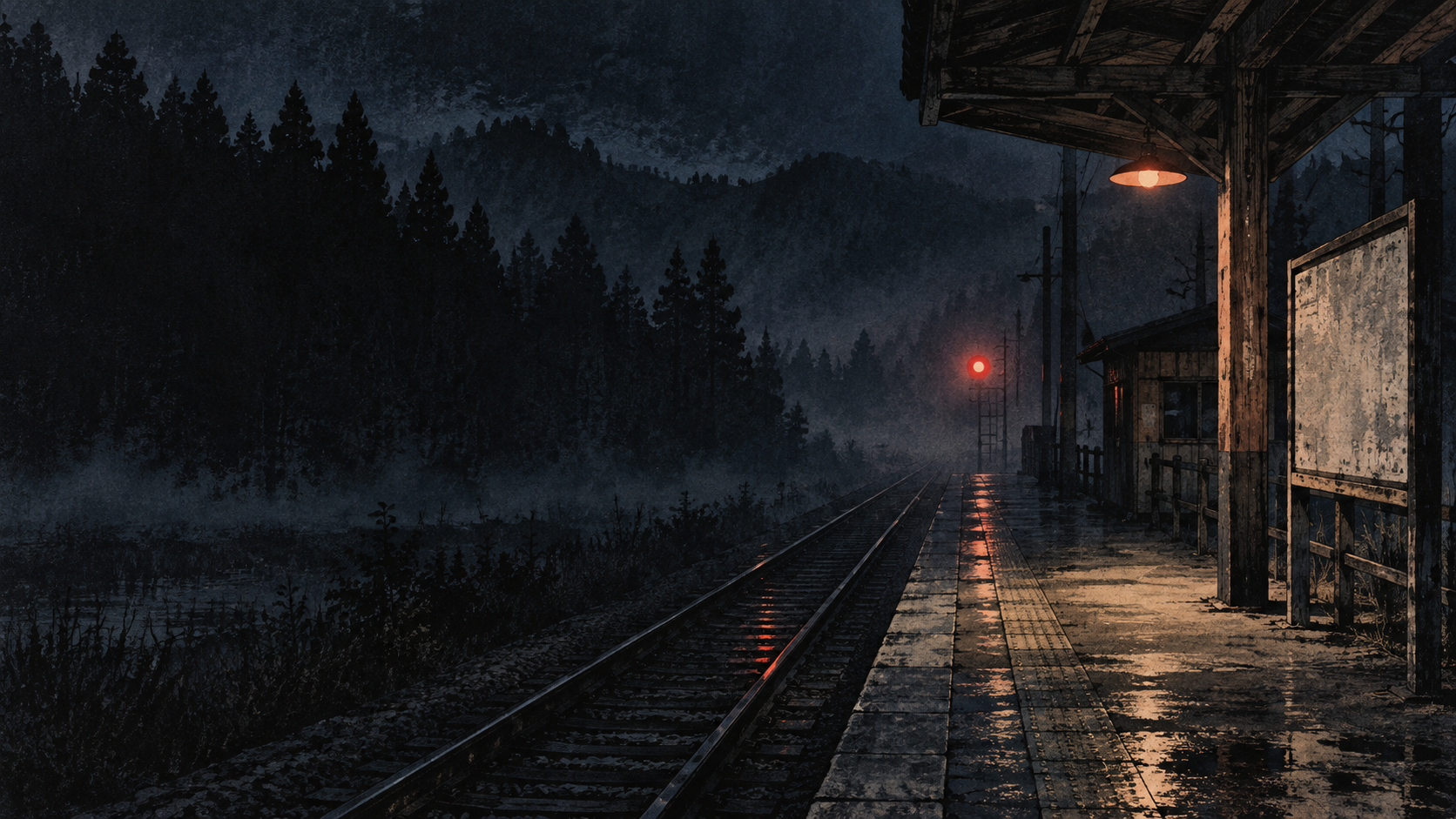 Original editorial artwork
January 2004 · Shizuoka, Japan
Kisaragi
Station
A commuter misses the usual stop, steps onto a station that does not exist, and describes an apparent disappearance to strangers online in real time. This is the story — and the record behind it.
From the archive
19 more field notes from the edge of the network.
Urban legend · 1979
Kuchisake-onna
The slit-mouthed woman: a 1978 Gifu rumor that became a national school panic in 1979.
Forum folklore · 2000
Kunekune
A 2000 web story, a 2001 2channel post, and the 2003 thread that named the white figure in the rice field.
Web curse · 2003
The Red Room
Akai Heya: a Flash horror work and web curse about a red pop-up you cannot close.
School ghost · c. 1948
Hanako-san
A c. 1948 Iwate rumor that grew into Japan’s best-known school-toilet legend.
Forum folklore · 2008
Hachishaku-sama
A single 2008 2channel post about an eight-shaku visitor, the sealed room, and the 2021 revival.
School ghost · c. 1980
Teke Teke
An Okinawan recollection c. 1980, 1990s school-ghost books, a separate railway legend, and the 2009 film.
Place legend · 1999
Inunaki Village
The village is a legend; the closed tunnel and the dam are real. What is documented and what is rumor.
Dream netlore · 2000
Saru Yume
An August 2000 forum post about a dream train — what the original said and what retellings added.
Cursed object · 2005
Kotoribako
A June 2005 forum story, not an old Shimane tradition — how it was built and why its framing matters.
Divination craze · 1880s
Kokkuri-san
From Meiji-era table-turning to the coin-and-paper game of 1970s classrooms: what is documented about Kokkuri-san.
Forum ritual · 2007
Hitori Kakurenbo
The 2channel-era ritual in which a doll plays “it”: its 2007 spread, the media wave, and why it is better read than tried.
Rumor boom · 1989–90
Jinmenken
The dog with a tired man’s face: the 1989–90 rumor boom, its Edo-period precursors, and the magazine theory.
Rumor · 1930s
Aka Manto
How a 1930s rumor about a red-caped kidnapper became the “red cape or blue cape?” voice in school toilets.
Temple doll · Hokkaido
The Okiku Doll
The doll at Mannenji temple in Iwamizawa said to grow hair: the temple’s account and the versions that disagree.
Place legend · Aomori
Sugisawa Village
A village said to be wiped out in one night and erased from the records: a late-1990s TV feature, a web boom, and real models.
Cursed text · 1919 / 2004
Tomino’s Hell
Saijō Yaso’s 1919 poem and the modern warning that reading it aloud brings misfortune.
Writers’ legend · 1965
Ushi no Kubi
The ghost story no one will repeat: Komatsu Sakyō’s 1965 tale, a 1973 essay, and a possible 1926 predecessor.
Forum folklore · 2001
The Samejima Incident
A 2001 2channel legend of an incident too terrible to describe, and the thread, rules and films that kept it alive.
Place legend · Kyoto
Kiyotaki Tunnel
A 1929 railway tunnel turned one-lane road: what is documented, what is rumor, and why the signal became the legend.
How we work
Translation is the beginning,
not the finished article.
Trace
Find the earliest available record and distinguish it from later retellings.
Context
Explain the language, place, technology, and cultural references an overseas reader may miss.
Separate
Label documented facts, reported claims, and interpretation so they never blur together.